


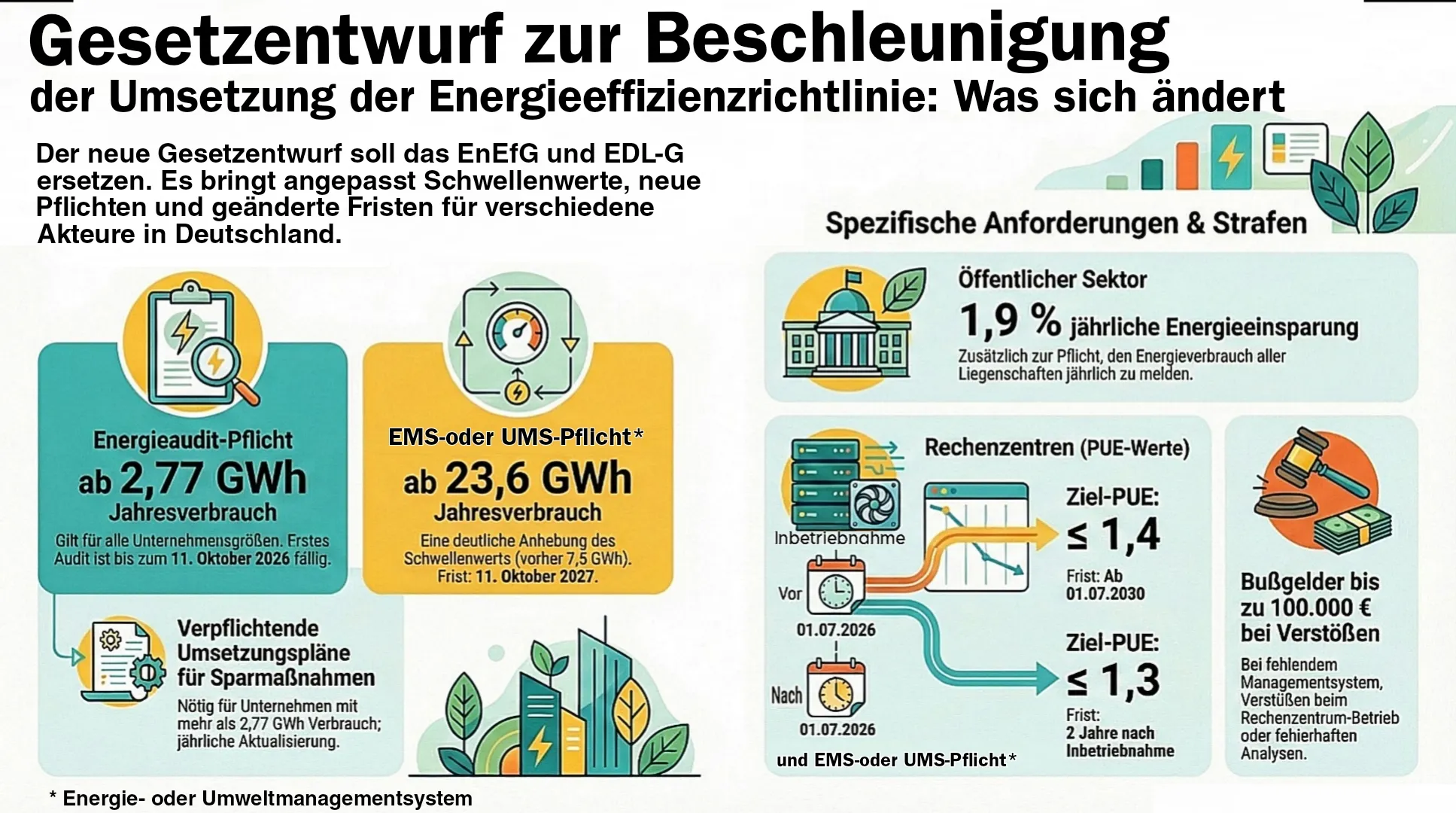
Bill to Accelerate the Implementation of the Energy Efficiency Directive
Important Legal Notice:
This summary is based on the current draft bill for the implementation of the EU Energy Efficiency Directive (EED) and the amendment of the EnEfG. Please note that details may still change during the ongoing legislative process.
Update from September 16, 2026: The federal government’s draft bill has now been submitted to the Bundestag as printed matter 21/8027. You can download the full document here:
Currently, the Energy Efficiency Act (EnEfG) of November 13, 2023, and the Energy Services and Other Energy Efficiency Measures Act (EDL-G) are in force in Germany. These two laws are to be replaced and merged by a new law to accelerate the implementation of the EED.
The following overview summarizes the key contents and new obligations for companies.
1. Obligations for Companies – Energy Audit
Companies with an annual total energy consumption between 2.77 GWh and 23.6 GWh will be obliged to conduct an energy audit according to DIN EN 16247-1 – regardless of whether they are SMEs or non-SMEs.
- First energy audit: by October 11, 2026, at the latest
- Repetition: every four years
The main changes compared to the previous legal situation:
- Relief for non-SMEs: Previously, non-SMEs were subject to audits from 500,000 kWh. This limit is abolished in favor of the new thresholds.
- New obligation for energy-intensive SMEs: SMEs with consumption between 2.77 and 23.6 GWh will now be subject to audits. Previously, the obligation was based purely on SME status, not on consumption.
Exemption Possibilities and Stricter Content
Companies can be exempted from the audit obligation if:
- a certified energy management system (ISO 50001) or environmental management system (EMAS) has been implemented, or
- an energy performance contracting agreement exists.
Stricter content requirements:
In the future, the audit must also identify and document potentials for the economic use or generation of renewable energies.
2. Obligation to Implement Management Systems
An energy (ISO 50001) or environmental management system (EMAS) will become mandatory for all companies once an annual total energy consumption of more than 23.6 GWh is reached (previously 7.5 GWh in the EnEfG).
- Implementation deadline: by October 11, 2027, at the latest
- Coverage: The system must cover at least 90% of the total energy consumption.
3. Implementation Plans for Final Energy Saving Measures
Companies with a total energy consumption of more than 2.77 GWh (on average over the last 3 years) are obliged to create and publish implementation plans. This obligation also applies to companies with a certified management system.
- Deadline: within three months after completion of the audit or (re-)certification.
- Content: Only measures identified as economically viable may be included (assessment according to DIN EN 17463 / VALERI).
- Information obligation: Management must confirm implementation; the plans must be published.
4. Public Sector (excluding state authorities)
Two central obligations apply to public institutions:
- Data collection and reporting: One-time reporting of data from 2021 (reference). From 2025, annual submission to the energy consumption register (deadline: November 1, 2026).
- Savings target: Annual energy saving obligation of 1.9% (final energy), excluding public transport.
5. Requirements for Data Centers
Specific requirements for Power Usage Effectiveness (PUE) apply to data centers:
Commissioning before July 1, 2026:
- PUE ≤ 1.6 from July 1, 2027
- PUE ≤ 1.4 from July 1, 2030
Commissioning after July 1, 2026:
- PUE ≤ 1.3 (to be met within two years of commissioning)
Additional obligations:
Implementation of an energy management system (validation not mandatory unless required by thresholds). Exception for heat utilization: If at least 50% of the reused energy (waste heat) is fed into a heating network
6. Waste Heat Utilization and Cost-Benefit Analysis
An important technical requirement applies here for industrial plants in new construction or comprehensive modernization.
Operators of plants with an average total nominal thermal input (input) of more than 8 MW are obliged to conduct a cost-benefit analysis (CBA) for waste heat utilization.
- For data centers, this obligation applies from a connected load of 1 MW.
- Simplification: The previous blanket reporting obligation for waste heat in the online portal for companies > 2.5 GWh is no longer required in its old form.
7. Controls and Fines
The Federal Office for Economic Affairs and Export Control (BAFA) continues to conduct spot checks.
Administrative offenses can result in severe fines:
- Up to 100,000 Euros for violations of:
- the obligation to implement a management system.
- requirements for data centers.
- the creation of the cost-benefit analysis.
- Up to 50,000 Euros in all other cases (e.g., missing audit, unpublished implementation plan).
8. Our Questions to Your Answers
Question: What is considered a company?
A company is any entity that is economically active, regardless of its legal form.
This means: Anyone who regularly offers goods or services is considered a company. This includes, for example, craft businesses, sole proprietorships and family businesses, partnerships, and associations or groups that are regularly economically active.
Whether a profit is made is irrelevant. Even non-profit, church, or social organizations can be considered companies if they offer services or products on the market.
The obliged company is always the smallest legally independent entity that keeps its own books and prepares financial statements for commercial or tax reasons. This also includes branch offices, subsidiaries, and individual businesses or business units.
Legally independent subsidiaries are each considered separate companies ((see BAFA leaflet on determining total final energy consumption from 17.07.2024)
Question: How is a company's total energy consumption calculated?
Total energy consumption (total final energy consumption) is the total final energy that a company consumes across all areas within a defined period. The thresholds mentioned in the law refer to the average energy consumption of the last three years.
For determining total final energy consumption at the final energy level, there is a BAFA leaflet for companies obliged under § 8 EDL-G and §§ 8, 9 and 17 EnEfG.
All energy consumption of the company must be taken into account in the total final energy consumption. This includes all own and self-used buildings and sites, all rented buildings and sites, and all other energy consumers in the company, such as machinery, equipment, production processes, and the vehicle fleet.
Rented buildings are always considered by the company that actually uses or has rented them, not by the owner.
The energy consumption of partner companies or affiliated companies is not aggregated. Each obliged company is always considered individually. Total energy consumption includes all energy sources used, such as electricity, natural gas, district heating, lignite or hard coal, as well as self-generated electricity, for example from a photovoltaic system, if it is used within the company.
The following energy consumptions are not taken into account, among others:
- Aircraft fuels and bunker oils for maritime shipping
- Energy that is only passed on to third parties and not used by the company itself
- Energy consumption outside Germany
- Energy consumption for international transport, unless it starts in Germany and the company is based in Germany
- Energy consumption of company cars with private use
- Energy for the transport of goods or persons carried out by third parties
- Energy consumption of employees in home offices
- Grid and transmission losses
- Final energy from ambient heat, cold, or solar thermal energy
- Material use of energy sources
- Final energy consumption of listed technical installations (excluding buildings)
- If energy sources are used exclusively for material purposes (e.g., as raw materials, operating materials, or auxiliary materials), they do not count towards energy consumption. Example: Wood for furniture production does not count, but wood or wood waste for heating or operating machinery does.
Question: What are the differences between an energy management system according to ISO 50001 and EMAS?
An energy management system according to ISO 50001 focuses exclusively on a company’s energy consumption. It is generally more cost-effective, requires less documentation, and no mandatory public environmental reporting.
EMAS (Eco-Management and Audit Scheme), on the other hand, is a comprehensive environmental management system that covers not only energy but also other environmental issues such as emissions, waste, water, and resource use. It includes regular external audits, a mandatory environmental statement, and public reporting. As a result, EMAS is significantly more complex and costly, but offers greater transparency and a broader environmental approach.
Comparison: ISO 50001 vs. EMAS
ISO 50001 (Energy Management System)
- Lower costs
- Focus exclusively on energy
- Less documentation
- No mandatory environmental reporting
- Certification usually more cost-effective
➡️ Generally significantly cheaper than EMAS
EMAS (Environmental Management System)
- Higher costs
- Includes energy + environment (waste, emissions, water, resources)
- Mandatory environmental statement
- External environmental auditors
- Regular validation and publication
➡️ Significantly more costly
Question: Does the energy or environmental management system have to cover the entire company, or are individual sites sufficient?
An energy or environmental management system must cover at least 90% of a company’s total final energy consumption. For this, the company’s total energy consumption (100%) must first be determined. If, for example, one or two sites together account for more than 90% of energy consumption, it may be sufficient to include only these sites in the management system.
Since certification usually takes place at the company level, in such cases, coordination with DAkkS or the responsible certification body is required to ensure recognition.
Question: What are implementation plans and what does "create and publish" mean?
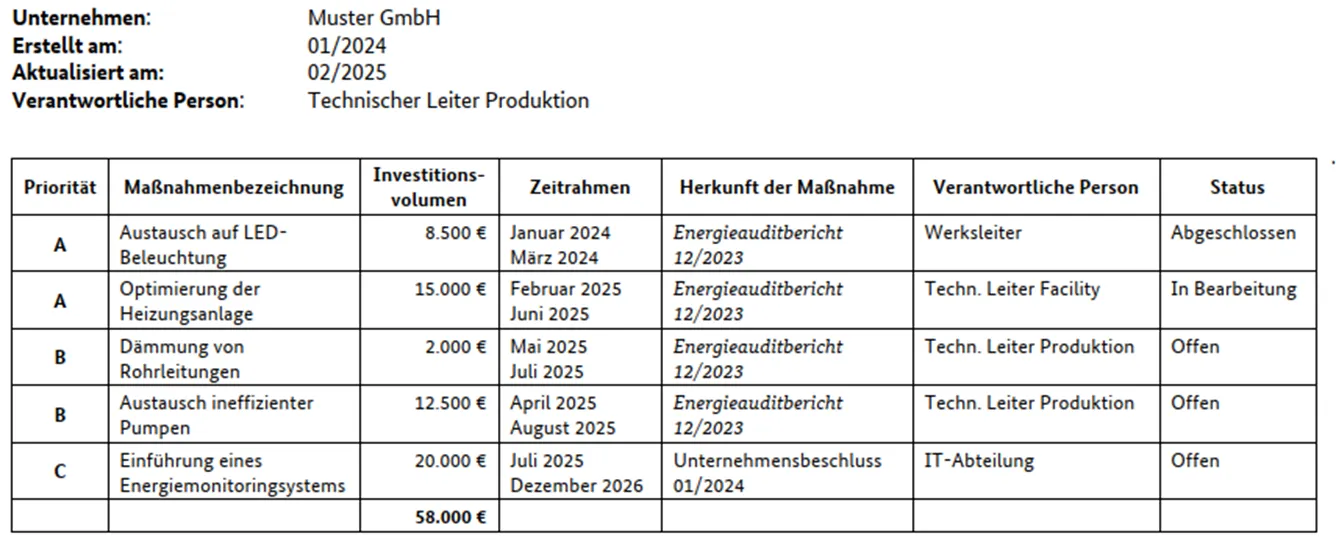
An implementation plan is an action plan for energy saving measures that summarizes the planned measures and presents their implementation status. The measures can, for example, originate from an energy audit or from an energy or environmental management system and must be economically feasible. The implementation plan must be submitted to management.
“Create” means to systematically document these measures. “Publish” means to make the implementation plan publicly accessible, for example, via the company website or by integrating it into a publicly available sustainability report.
Below is an example from the Federal Office for Economic Affairs and Export Control (BAFA) that shows what an implementation plan can look like.
Question: When is a measure considered economically viable?
A measure is considered economically viable if the economic viability calculation according to DIN EN 17463 results in a positive net present value. This checks whether the measure pays for itself at the latest after 50% of its useful life. Only measures with a maximum useful life of 15 years are considered. The depreciation tables of the Federal Ministry of Finance must be used to determine the useful life.
Example (Lighting):
As an example, the measure for renewing lighting from conventional technology to LED is considered. First, the annual energy savings are calculated and compared with the investment costs.
The economic viability calculation is carried out according to DIN EN 17463. For an assumed useful life of 15 years, the net present value is determined for each year.
If the net present value is positive at the latest after 50% of the useful life, i.e., after 7 years, the measure is considered economically feasible.
From our experience – especially due to the increased electricity prices in recent years – measures for switching to LED lighting are almost always economically feasible in practice.
Question: From when is something considered a data center?
In the context of the draft bill for the law to accelerate the implementation of the Energy Efficiency Directive, the following terms apply:
A data center is a facility where IT systems are operated. Such a facility is considered a data center if the installed IT has an electricity demand of at least 500 kilowatts.
1. An operator of a data center is:
anyone who owns a data center or uses the space for it (e.g., for server rooms) or has comparable rights of use.
This also includes companies that provide space for so-called co-location services.
2. An operator of information technology is:
anyone who operates their own IT systems (e.g., servers, storage, network technology) within a data center,
- with an electrical connection capacity of at least 50 kilowatts,
- regardless of whether they own this technology or use it on another legal basis,
- without operating the data center itself in which this technology is located.
3. Co-location means:
that a data center provides technical infrastructure (e.g., power supply, cooling, security) where customers can install and operate their own IT equipment.